· 9 min read
What Is Tinikling? An Australian Guide to the Filipino Bamboo Dance
What is Tinikling? Learn how the Filipino bamboo dance works, what its history can reliably tell us, and how Australians can watch or learn it respectfully.
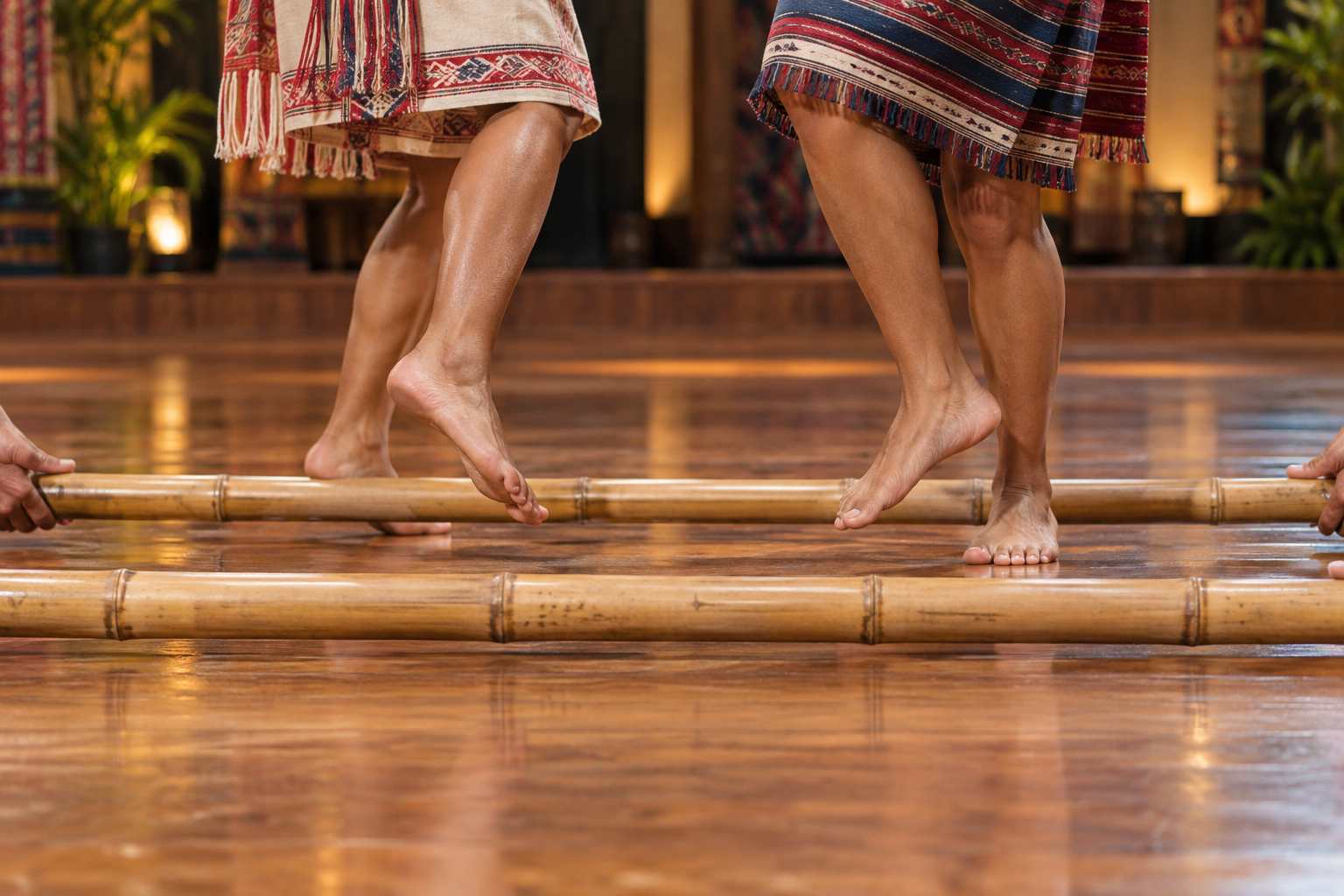
What is Tinikling?
Tinikling is a Philippine folk dance in which dancers step around and between parallel bamboo poles while other performers move the poles in a repeated rhythm. The dancers must place and lift their feet precisely as the poles slide apart and clap together. That combination of music, timing, agility and teamwork has made Tinikling one of the most recognisable Filipino dances in the Philippines and in communities overseas.
For an Australian seeing it for the first time, the bamboo may attract the eye, but Tinikling is more than a speed challenge. It is a coordinated performance shared by dancers, musicians and pole operators. School, community and professional versions may differ in tempo, arrangement and costume because folk dance is transmitted, taught and restaged rather than frozen in one universal form.
This guide answers the practical question ‘what is Tinikling?’ while separating well-supported cultural history from attractive stories that are often repeated without clear evidence.
How the bamboo-pole pattern works
A basic Tinikling arrangement uses two long bamboo poles laid parallel, with each end managed by a seated or kneeling operator. The operators slide or tap the poles against the floor or supports, then bring them together. Dancers time their steps so their feet move inside and outside the poles without being caught. More elaborate presentations can add pairs, formations, turns and accelerating sequences, but the relationship between moving poles and responsive footwork remains central.
The operators are performers, not passive stagehands. Their tempo must be consistent, their movements must match one another and they must respond safely if a dancer loses the pattern. The dancers, in turn, listen as much as they look. The sound of bamboo striking bamboo and floor creates an audible framework for the steps.
Tinikling makes rhythm visible: a musical pulse becomes a physical space that repeatedly opens and closes. Confidence comes from cooperation, not from simply outrunning the poles.
Where does Tinikling come from?
Tinikling is commonly associated with Leyte in the Eastern Visayas. Descriptions also connect its name and movement imagery with tikling birds, a Filipino term used for rail-like birds that move quickly through grass and fields. The familiar explanation is that the dancers imitate the birds’ alert, nimble steps as they avoid stems, traps or other obstacles.
It is sensible to present that bird connection as a traditional interpretation rather than a laboratory-style account of how one choreographer invented the dance on a known date. Folk practices usually develop through communities and oral transmission. Later collectors, teachers and companies may record or arrange a version, but documentation is not the same as the moment of origin.
You may also encounter a dramatic story claiming that Tinikling began with Filipino workers avoiding bamboo poles used as punishment during Spanish colonial rule. That story is widely circulated online, yet it is difficult to support with strong primary historical evidence. It should not be presented as settled fact. A careful account can acknowledge that the story exists while being honest about the limits of the record.
What the name Tinikling means
The name is generally explained through tikling, referring to the birds evoked by the dance, while the Filipino verbal form suggests doing something in the manner of a tikling. In performance, the connection is conveyed through quick, light footwork and skilful avoidance rather than through a literal bird costume or a fixed storyline.
This distinction matters because cultural explanations can become oversimplified when translated for tourism or school projects. Saying that the dance evokes tikling birds is more accurate than claiming every step has one authorised symbolic meaning. A performance can communicate alertness, grace and playfulness without functioning as a word-for-word narrative.
How Tinikling entered classrooms and national stages
The work of Francisca Reyes Aquino is essential to understanding how Philippine folk dances were researched, notated and taught during the twentieth century. The National Commission for Culture and the Arts recognises Aquino as a National Artist for Dance and a pioneer of Philippine folk-dance research. Beginning in the 1920s, she travelled to communities, recorded dances and produced books used by educators.
Aquino’s 1926 thesis, Philippine Folk Dances and Games, and later publications helped turn embodied local practices into written teaching material. Her work with the education system also enabled dance descriptions to circulate widely. WorldCat and HathiTrust catalogue successive volumes of her Philippine Folk Dances, which combined music and instructions rather than treating dance as movement without sound or context.
Academic research has examined what happens when community practice moves into the academy or onto a national stage. Declan Patrick’s Asian Theatre Journal article describes an evolving relationship among embodied practice, research and institutional presentation. The version many people learn is part of a teaching lineage, not proof that every local performance has always looked identical.
Is Tinikling the national dance of the Philippines?
Tinikling is often called the Philippine national dance in informal descriptions, and it unquestionably has strong national visibility. However, popularity and official legal designation are not the same thing. It is safer to describe Tinikling as one of the best-known Philippine folk dances unless a reliable government instrument is cited for a formal title.
Its recognisable poles and energetic presentation have made it a frequent choice for schools, touring groups and Filipino community events. It can introduce Philippine dance, but it cannot summarise an archipelago with many ethnolinguistic communities and movement traditions.
A respectful program can present Tinikling as one doorway, then encourage audiences to learn about other dances and the communities from which they come. The Hernandez guide to bayanihan offers another way to explore Filipino community values beyond performance.
Music, clothing and performance variations
Tinikling is commonly performed with music in triple metre, while the poles contribute a strong percussive layer. The precise tune, instruments, tempo and number of dancers vary with the setting and arrangement. Recorded music may be used in a classroom or community hall; live musicians can create a more responsive exchange with dancers. Neither choice by itself proves that a performance is more authentic.
Costumes also vary. Staged presentations may use rural-inspired dress, including versions of the balintawak or patadyong for women and a barong-style shirt with trousers for men. These are broad descriptive conventions, not permission to label any colourful outfit as the single traditional Tinikling costume. Regional textiles and formal garments have their own histories, and performers should identify what they are actually wearing.
The Barong Tagalog, for example, is a specific Filipino garment with its own materials, development and social meanings. Treating it as a generic prop misses that history. Good cultural presentation credits the dance arrangement, music and clothing choices instead of allowing visual familiarity to substitute for context.
Tinikling and Singkil are not the same dance
Australians sometimes group every Philippine dance involving bamboo poles under the name Tinikling. That can erase important distinctions. Singkil is associated with Maranao cultural material from Mindanao and is often presented through staged interpretations connected with the Darangen, the Maranao epic recognised by UNESCO as intangible cultural heritage. Tinikling is commonly associated with Leyte and the Eastern Visayas.
The presence of bamboo does not make the two dances interchangeable. Their movement vocabularies, music, dress, cultural setting and performance histories differ. If a program includes either one, use the correct name and consult knowledgeable cultural practitioners rather than borrowing costume, narrative or music from the other.
Why Tinikling travels well across communities
Tinikling has qualities that communicate quickly across language barriers. An audience can hear the beat, see the narrowing space and understand the skill required within seconds. The poles create a portable stage picture, while the pattern can be expanded from a simple demonstration into a polished ensemble work.
For Filipino communities overseas, Tinikling can support cultural education and shared memory. Children and adults can participate at different skill levels, while an explanation can introduce geography, language and dance history. It should not be reduced to an exotic spectacle or speed contest. Context distinguishes cultural sharing from a decontextualised stunt.
At a Filipino fiesta or community gathering, dance, food and social participation may sit alongside one another. If you are planning a Bunbury celebration, discuss the event’s purpose, performers and acknowledgements separately from the catering order. Hernandez Asian Delights can help with Filipino food, while cultural performance should be led by people with suitable knowledge and rehearsal time.
Explore Filipino fiesta traditions →Ask about Hernandez catering →
How to watch or present Tinikling respectfully in Australia
Begin with accurate naming. Introduce Tinikling as a Philippine folk dance commonly associated with Leyte, explain the role of the bamboo-pole operators and avoid presenting an uncertain origin legend as proven history. If a Filipino cultural group, teacher or choreographer created the arrangement, credit them clearly.
Avoid describing the dance as primitive, tribal or merely dangerous. Those labels flatten a sophisticated coordination practice and can confuse distinct Philippine communities. Photography and video should follow the performers’ consent rules, especially at community events involving children. If you are invited to join, listen to the teacher and do not step into a working set of poles without instruction.
Food can complement a cultural event without being used as evidence that every Filipino family celebrates in one way. Visitors can browse the Hernandez store, learn about kamayan or order pork crackle for an appropriate gathering, but availability and dietary details should always be confirmed directly.
Visit the Hernandez store →Read the Australian guide to kamayan →Order Hernandez pork crackle →
Can beginners learn Tinikling safely?
Yes, beginners can learn simplified Tinikling patterns, but the moving poles create a real risk of bruised feet, trapped fingers and falls. Learn from an experienced instructor in a clear, non-slip space. Pole operators should practise the rhythm without dancers first, agree on a stop signal and keep their hands away from collision points. Dancers should start at a slow, steady tempo rather than treating acceleration as the goal.
A teacher may begin with floor markings, ropes or lightweight training props before introducing bamboo. That allows learners to understand inside-and-outside foot placement without the consequence of mistiming a closing pole. Suitable footwear depends on the floor, production and teacher; bare feet should never be assumed to be automatically safer.
The best first session develops listening, balance and trust. Speed can come later, if the group is ready. Stop immediately if the rhythm breaks down or a participant is uncomfortable. These precautions are practical guidance, not a substitute for instruction or a venue-specific risk assessment.
The clearest way to understand Tinikling
Tinikling is best understood as a living Filipino dance practice built on rhythm and cooperation. Its bamboo poles create the familiar challenge, but the dance’s cultural value lies in the relationship among movement, music, teaching and community. It is commonly linked with Leyte and tikling birds, while dramatic colonial-origin stories should be treated cautiously unless stronger evidence is produced.
For Australians, respectful appreciation begins with curiosity and precision: use the correct name, credit teachers and performers, recognise variation and do not confuse Tinikling with other Philippine dances. Watch the teamwork as closely as the footwork. That is where the dance’s apparent lightness is supported by discipline, listening and shared timing.
Frequently asked questions
What does Tinikling mean?
The name is generally connected with tikling birds and performing movement in their nimble manner. The dance evokes alert footwork as performers step between moving bamboo poles, rather than telling one fixed literal bird story.
Is Tinikling officially the national dance of the Philippines?
Tinikling is frequently called the national dance in informal sources, but popularity is not the same as formal legal designation. It is accurate to call it one of the Philippines’ best-known and most widely performed folk dances.
Where did Tinikling originate?
Tinikling is commonly associated with Leyte in the Eastern Visayas. Its precise beginnings are difficult to reduce to one documented event because folk dances develop through community practice and are later collected, arranged and taught in different forms.
Are Tinikling and Singkil the same?
No. Both may use bamboo poles, but Tinikling is commonly associated with Leyte and the Eastern Visayas, while Singkil is associated with Maranao cultural material from Mindanao and staged interpretations connected with the Darangen. Their music, dress, movement and contexts should not be mixed.
Can children and beginners learn Tinikling?
They can learn simplified patterns with an experienced teacher, a clear non-slip space and a slow tempo. Beginners can first use floor markings, ropes or lightweight props. Pole operators should rehearse separately and everyone should agree on an immediate stop signal.
Keep exploring Filipino food and culture



Taste it in Bunbury
Bring Filipino flavour to your next gathering.
Explore catering from Hernandez Asian Delights or visit Michael and the team at 36 Charles Street, Bunbury.