· 9 min read
What Is a Jeepney? An Australian Guide to the Philippines’ Iconic Transport
What is a jeepney? Learn how this Philippine public transport vehicle developed, how it works, what its art means and why modernisation is debated.
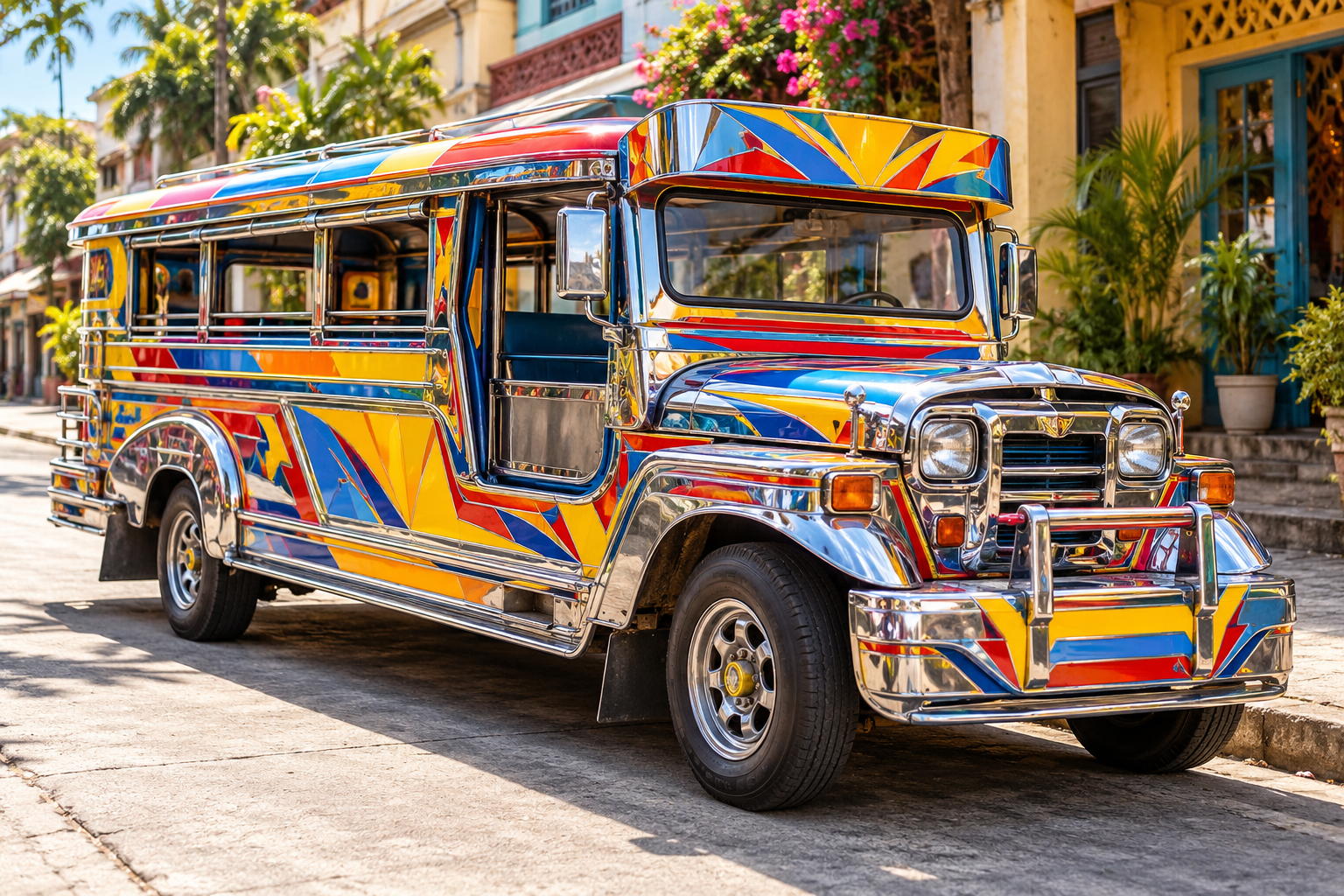
What is a jeepney?
A jeepney is a Philippine public utility vehicle that carries passengers along a set route. The traditional form has a long metal body, a roof, open or windowed sides and two inward-facing bench seats behind the driver. Passengers usually enter at the rear. Route boards or signs identify the places the vehicle serves, while the exterior may combine polished metal, bright paint, lettering and personal decoration.
The simplest comparison for an Australian reader is a small, independently operated route bus, but that description misses much of its character. Jeepneys became part of ordinary commuting after the Second World War, supported countless driver and operator livelihoods, and developed a visual language recognisable far beyond the Philippines. They are practical vehicles, workplaces and cultural objects at the same time.
Not every jeepney now looks like the familiar chrome-and-colour vehicle in travel photography. Modern units can resemble minibuses and may use newer diesel engines or electric power. Traditional and modern vehicles can therefore share a route while offering quite different layouts, access, ventilation and payment arrangements.
How did the jeepney begin?
The best-documented account begins in the aftermath of the Second World War. Academic researcher Gina Gatarin explains that Filipino makers refashioned military jitneys left by Americans at a time when war damage had weakened mass transport. The vehicles were adapted and lengthened to carry more people, then developed into a locally manufactured form rather than remaining unchanged military jeeps.
That distinction matters. Calling a jeepney merely an old American jeep erases the Filipino work that made it suitable for public transport. Body builders extended chassis, added roofs and passenger benches, changed the rear and created new bodies around available engines and parts. Over time the resulting vehicle became larger, more specialised and more visually expressive than its military starting point.
It is also wise to be cautious with neat origin stories. Publications repeat different explanations for the word jeepney, often linking jeep with jitney, an English term for a small shared vehicle. Rather than presenting an uncertain word origin as settled fact, it is safer to focus on what historians consistently document: post-war adaptation answered an urgent mobility need and Filipino enterprise transformed the vehicle into a distinctive public service.
What makes a traditional jeepney distinctive?
A traditional jeepney is built for frequent boarding on a route rather than for private motoring. Long benches face one another, allowing a relatively compact vehicle to carry a group. The driver’s area is at the front, while passengers pass fares and messages through the cabin. A roof protects the interior from sun and rain, and the open rear makes boarding quick, although exact construction varies by maker, period and location.
The exterior is where function meets personal expression. Polished stainless steel, painted panels, names, religious imagery, popular-culture references and lettering have all appeared on jeepneys. Decoration can identify an owner’s taste or aspirations, but there is no single mandatory style. Some vehicles are exuberant; others are workmanlike. Modern fleet vehicles may use standardised liveries and route information instead of highly individual artwork.
Frankfurter Buchmesse, which used a Philippine-built jeepney as the centrepiece of a 2025 cultural program supported by the Philippines as Guest of Honour, described it as individually designed and deeply rooted in everyday life. That international use shows how the vehicle can represent both movement and Filipino community without claiming that every design carries the same symbolic message.
How does a jeepney route work?
Jeepneys generally operate on authorised routes, with origin, destination and important stops displayed on boards or signs. A rider chooses a vehicle whose sign matches the intended direction, boards where local rules allow and tells the driver where they will leave. Routes, stopping practices and terminals differ between cities and provinces, so local knowledge remains important.
Traditional services are often associated with cash fares. Passengers may pass money forward through other riders, and change returns the same way. The custom demonstrates everyday cooperation, but a visitor should not treat it as a performance to stage for photographs. Prepare a manageable amount, observe how local passengers communicate and follow the driver’s instructions. Modern services may use conductors, electronic systems or different boarding arrangements.
Fares and routes can change, so a current local source is more reliable than an old travel blog. Ask your accommodation or a trusted local contact to confirm the route, operating hours, fare and safe boarding point. Do not assume that a vehicle with a familiar place name will travel directly to a specific hotel or attraction.
Useful words and respectful passenger etiquette
In Filipino, bayad po is a polite way to signal that you are paying, while para po asks the driver to stop. Po adds respect. These phrases can help, but clear communication matters more than performing perfect pronunciation. State the destination, listen to any correction and thank people who help pass a fare or make space.
Keep bags compact and out of the aisle, avoid blocking the rear opening and move along the bench when room is needed. Do not photograph drivers or passengers closely without permission. A jeepney is a workplace and shared commute, not simply a colourful tourist prop. Hold on when the vehicle moves and never board or alight while it is still in motion.
Accessibility varies considerably. Traditional rear entry, steps, narrow movement space and bench seating may not suit every traveller. A modern unit may offer improved access or other safety features, but this is not guaranteed. People with mobility, sensory or medical requirements should arrange transport that they have confirmed meets their needs.
Why is the jeepney culturally important?
The jeepney’s importance comes from use as much as appearance. For generations it has connected homes, schools, markets and workplaces. It has also created livelihoods for drivers, operators, mechanics, dispatchers, body builders, painters and parts suppliers. That broad social role helps explain why policy changes around jeepneys are discussed in terms of labour and access as well as engines and emissions.
Its design is often read as an example of adaptation: imported military material was turned towards civilian need, then remade through local engineering and aesthetics. Yet words such as resilience and ingenuity should not romanticise difficult working conditions, congestion or unsafe equipment. Cultural respect means recognising both achievement and the real problems that passengers and transport workers want addressed.
Jeepneys also appear in art, souvenirs, community events and diaspora celebrations. Their image can open a conversation about Philippine history, but it cannot stand for every island, language or experience. Like tinikling or the Barong Tagalog, the jeepney is widely recognisable while still carrying regional, personal and political meanings.
Read the Australian guide to Tinikling →Learn about the Barong Tagalog →
Traditional and modern jeepneys
The Philippine government launched its Public Utility Vehicle Modernization Program in 2017. The program has pursued changes including newer vehicle standards, route planning and a shift from fragmented individual operations towards organised fleets. Modern vehicles may include side-facing or forward-facing seating, closed bodies, improved lighting, doors, cameras, speed limiters, air-conditioning or electronic fare equipment, depending on the model and service.
The case for reform includes cleaner technology, passenger safety, reliability and a more coherent public transport network. The concerns are equally substantial: vehicle finance, debt, consolidation, the livelihoods of small operators and drivers, and whether replacement services remain affordable and available. Gatarin’s peer-reviewed study argues that a just transition requires incremental change, inclusive dialogue and industry support rather than treating vehicle replacement as a complete solution.
This is why the common phrase jeepney phase-out can oversimplify a complex, changing policy. Traditional units have not vanished, modernisation has not produced one uniform vehicle nationwide, and implementation has involved extensions, disputes and local differences. As of 2026, Reuters still describes jeepneys as a vital mode of transport and reports that fuel costs directly affect driver earnings.
Should an Australian visitor ride a jeepney?
Understanding a form of transport is not the same as recommending it. Australian Government Smartraveller advice current on 25 September 2026 tells Australians to exercise a high degree of caution in the Philippines and advises avoiding public transport because of risks including robbery and violence. It recommends accredited rideshare providers or hotel hire cars, especially at airports. Higher travel-warning levels apply in parts of Mindanao and the southern Philippines.
Travellers should read the full current advice, not rely on a blog summary. Conditions can change quickly, and Smartraveller also notes that severe weather may disrupt transport and that air pollution can reach unhealthy levels, particularly in Manila. Your location, health, time of day and ability to navigate an unfamiliar route all matter.
If official advice changes and you consider any local public transport, make the decision using current government guidance, trusted local information and your own circumstances. Never board merely to obtain a photograph, and do not pressure a driver to deviate from a route. Learning about the jeepney remains worthwhile even when a safer transport choice is appropriate for your trip.
Common jeepney myths to avoid
First, not every jeepney on the road is an original wartime vehicle. Post-war jeeps provided an important template, but Philippine manufacturers built new bodies and the form continued evolving. Second, not every jeepney is covered in elaborate art. Decoration ranges from minimal route markings to dense custom painting.
Third, there is no single nationwide fare, timetable or boarding ritual. Public transport is regulated, yet practical details differ by route and place and can change. Fourth, modernisation is not a simple contest between people who love heritage and people who value clean air. Drivers, passengers, operators, planners and researchers can support safer, cleaner transport while disagreeing strongly about finance, pace and governance.
Finally, the jeepney is not a museum piece. It remains tied to daily mobility and household income. Cultural appreciation should leave room for Filipinos to debate what the vehicle becomes next.
Connecting with Filipino culture in Bunbury
Australians do not need to imitate a commute to appreciate the history behind the jeepney. Read Filipino researchers, listen to drivers and commuters, and notice how transport, food, work and community meet in everyday life. The same principle applies to Filipino dishes: ask about context and variation rather than searching for one version that represents an entire country.
In Bunbury, Hernandez Asian Delights offers a local starting point for Filipino flavours. Browse the store, enquire about catering for a community gathering or explore the pork crackle page when those services fit your plans. These links are not claims that jeepneys operate locally; they are ways to continue learning through a Filipino-owned South West business.
Visit the Hernandez Asian Delights store →Explore Hernandez catering →See the Hernandez pork crackle page →Browse more Filipino culture guides →
Frequently asked questions
What is a jeepney used for?
A jeepney is used for public passenger transport in the Philippines. It normally follows an authorised route and carries multiple passengers on benches or seats. Exact routes, stops, fares and vehicle layouts differ by location and operator.
Why are jeepneys so colourful?
Many owners and builders personalise traditional jeepneys with polished metal, paint, names, lettering and imagery. Decoration can express taste, identity or aspiration, but it is not compulsory. Some traditional jeepneys are relatively plain, and many modern units use standard fleet liveries.
Did jeepneys come from American military jeeps?
Post-Second World War military vehicles left by Americans were refashioned by Filipino makers to meet an urgent need for public transport. The design was lengthened and rebuilt for passengers, then developed into a locally manufactured vehicle with forms far removed from an unchanged military jeep.
Are jeepneys being phased out?
The Philippines has pursued a public transport modernisation program since 2017, including vehicle standards, route planning and fleet consolidation. Implementation is complex and contested, and traditional jeepneys have not simply disappeared. Current conditions vary, so avoid treating a single deadline or headline as the complete national picture.
Is it safe for Australian tourists to ride a jeepney?
Australian Government Smartraveller advice current on 25 September 2026 advises Australians to avoid public transport in the Philippines because of crime and security risks and to use accredited rideshare providers or hotel hire cars. Read the full current advice before travel because alert levels and conditions can change.
Keep exploring Filipino food and culture



Taste it in Bunbury
Bring Filipino flavour to your next gathering.
Explore catering from Hernandez Asian Delights or visit Michael and the team at 36 Charles Street, Bunbury.