· 9 min read
Filipino Leche Flan Recipe: Silky Caramel Custard for Australian Kitchens
Make a silky Filipino leche flan recipe with golden caramel, practical Australian measurements, a gentle water bath and reliable troubleshooting tips.
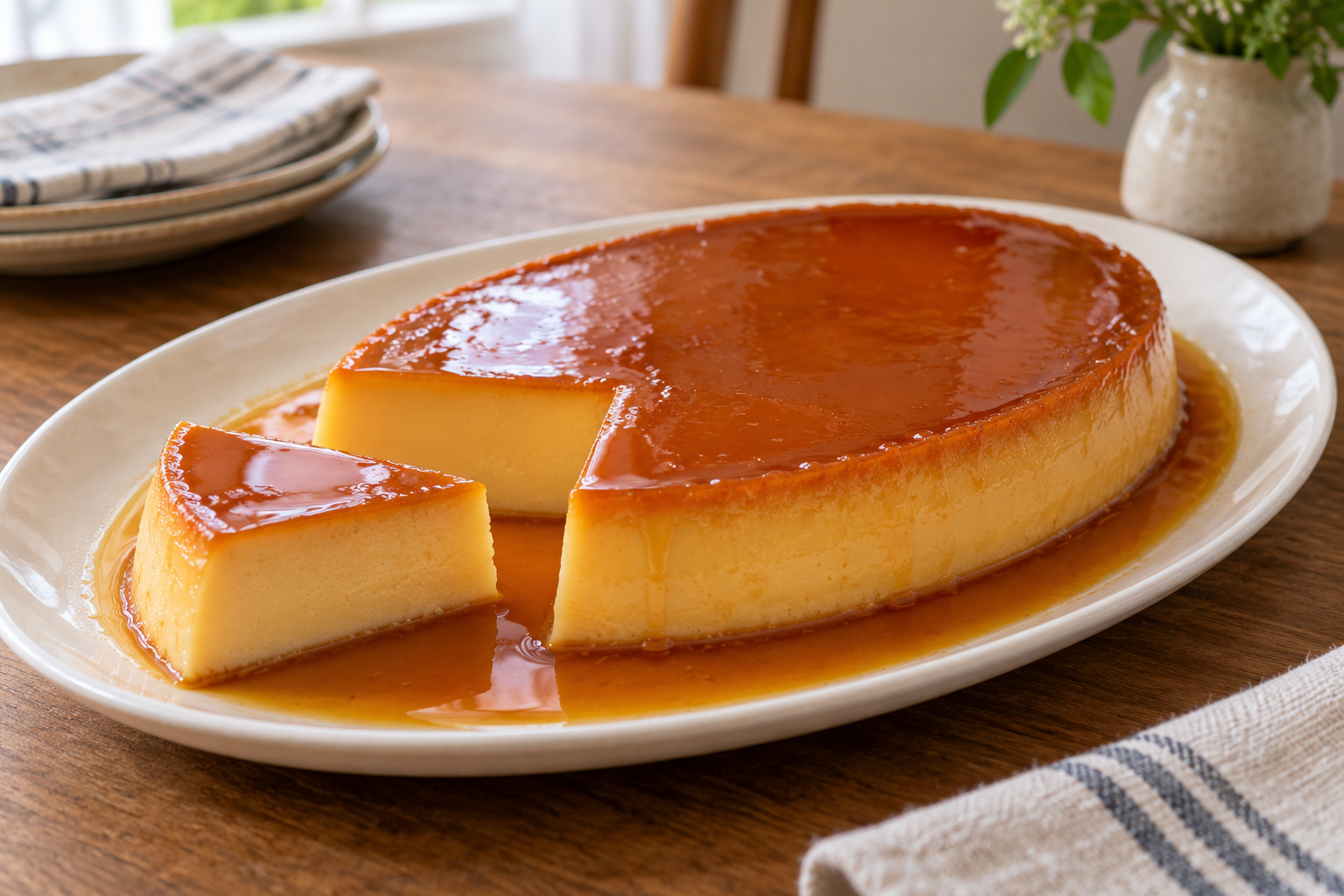
Filipino leche flan recipe: the short answer
Leche flan is a Filipino caramel custard with a smooth, rich centre and a glossy layer of caramel sauce. The custard is poured over set caramel, cooked gently, chilled, then inverted so the amber syrup runs over the top. It is familiar at parties, fiestas and other special occasions, and it also appears as a topping for desserts such as halo-halo.
This Australian-friendly oven recipe serves six and follows a published SBS Food method: 150 g caster sugar; four eggs plus two extra yolks; one 395 g tin of sweetened condensed milk; 250 ml evaporated milk; 160 ml full-cream milk; and one teaspoon vanilla extract. It bakes in a one-litre loaf tin at 160°C conventional—or about 140°C fan-forced—in a hot-water bath for approximately 40 minutes.
Gentleness matters: avoid whipping air into the eggs, strain the custard, use a water bath and stop baking while the centre retains a slight wobble. Cooling and chilling complete the set.
Start with the beginner’s guide to Filipino food →Learn what a Filipino fiesta is →
What makes Filipino leche flan distinctive?
Leche flan belongs to the wider family of caramel custards, but Filipino versions are commonly richer and denser than a light European-style crème caramel. Established Filipino recipe writer Kawaling Pinoy describes a classic version made with egg yolks, evaporated milk and sweetened condensed milk, cooked in oval metal moulds called llaneras. Whole-egg versions also exist, including the SBS recipe used here.
There is no single household formula. Some cooks use yolks only for density; others include whole eggs for structure. Vanilla is common, while calamansi or lime zest may brighten the richness. The flan may be steamed or baked in a bain-marie.
A recent Philippine Information Agency feature on the digitised historical cookbook Kusinang Tagalog notes that early versions of leche flan and other sweets were labour-intensive celebration foods. That history supports a useful modern principle: the dessert rewards patience. High heat and rushed unmoulding work against the texture that makes it special.
Ingredients and equipment for six servings
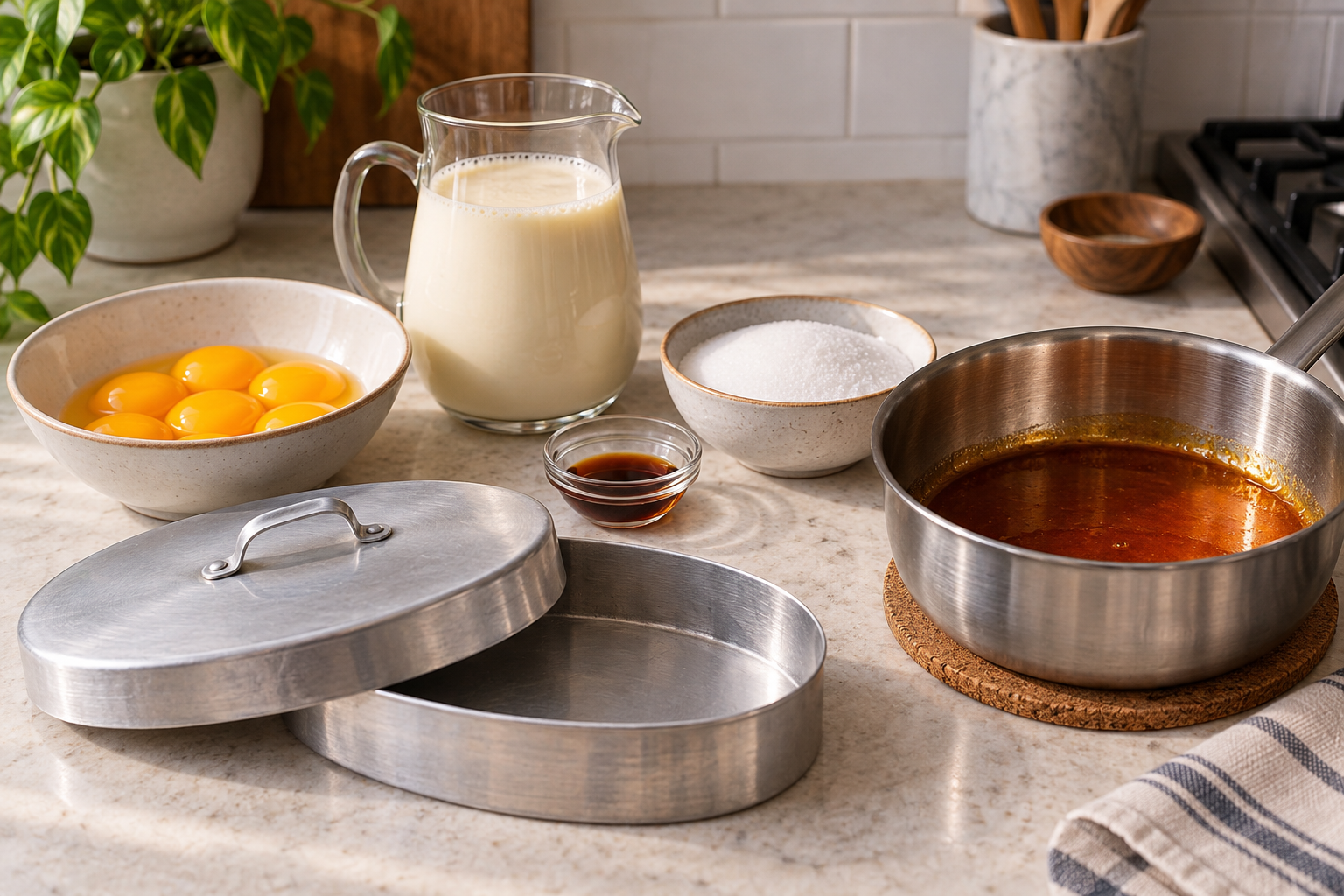
For the caramel, measure 150 g caster sugar. For the custard, use four large eggs, two additional egg yolks, one 395 g tin sweetened condensed milk, 250 ml evaporated milk, 160 ml full-cream milk and one teaspoon vanilla extract. SBS recipes use Australian measures: one teaspoon is 5 ml and one cup is 250 ml. No extra sugar is needed in the custard because the condensed milk is already sweetened.
You will need a one-litre metal loaf tin, fine sieve, mixing bowl, whisk, small saucepan and deep roasting dish. A traditional llanera is welcome but not essential; a metal loaf tin is a practical substitute with predictable capacity.
Choose intact, clean eggs and keep them refrigerated until needed. Use evaporated milk, not sweetened condensed milk, for the 250 ml component: the two tins have different functions and cannot simply be exchanged. Full-cream milk produces a rounder texture than reduced-fat milk. Check every label if cooking for someone with an allergy; this recipe contains egg and milk.
Step 1: make an even golden caramel
Preheat a conventional oven to 160°C, or reduce the setting by about 20°C for fan-forced. Lightly grease the loaf tin. Put the caster sugar in a clean, dry saucepan over medium heat. Let it begin to melt, then swirl the pan gently so the colour develops evenly. Do not walk away: caramel changes from golden to bitter very quickly.
The SBS method allows roughly eight minutes for the sugar to reach a dark caramel colour, but colour and aroma are better guides than the clock. Remove the pan when the caramel is a deep amber, before it smells burnt. Immediately pour it into the loaf tin and carefully tilt the tin to cover the base. Hot caramel causes serious burns, so use oven gloves and keep children away from the stove.
Leave the caramel for 20 minutes to cool and harden. It may crackle or look rigid; moisture and gentle heat turn much of it back into sauce during baking.
Step 2: mix a smooth custard without foam
Crack the four whole eggs into a bowl and add the two yolks. Whisk only until combined; vigorous beating traps air, which can leave small holes through the cooked flan. Add the condensed milk, evaporated milk, full-cream milk and vanilla. Stir steadily until the mixture is uniform rather than frothy.
Pour the mixture through a fine sieve into a clean jug or bowl. Straining catches stringy egg material and breaks up remaining lumps. If foam sits on the surface, let the mixture rest for several minutes and skim the bubbles with a spoon. Kawaling Pinoy likewise recommends gentle one-direction stirring, resting and straining for a silkier consistency.
Pour the strained custard slowly over the hardened caramel. Tap the loaf tin once or twice on a folded tea towel to release obvious air pockets, but do not splash the mixture. Covering with foil is optional for this oven method; if your roasting dish splashes easily, a loose foil cover can protect the surface from water droplets.
Step 3: bake gently in a water bath
Set the filled loaf tin inside the deep roasting dish. Place the dish on the middle oven rack before adding water so you do not carry a heavy, sloshing tray across the kitchen. Carefully pour boiling water into the outer dish until it reaches about halfway up the sides of the loaf tin. Keep water out of the custard.
Bake for about 40 minutes. Begin checking near the end rather than repeatedly opening the door. The outer custard should look set and the centre should move with a gentle wobble when the tin is nudged. It should not ripple like liquid or appear puffed and cracked. The residual heat continues to firm the custard as it cools.
The bain-marie buffers direct heat. If the water boils aggressively, the oven is too hot. Because ovens and tins vary, use the set edges and slight central wobble alongside the published timing.
Step 4: cool, chill and unmould cleanly
Remove the roasting dish from the oven. Using dry oven gloves, lift the loaf tin out of the water and place it on a heatproof rack. Let it stand for about 20 minutes, then allow it to cool further. Do not invert it while warm: the custard is still delicate and the caramel is very fluid.
Refrigerate the flan for at least one hour; several hours gives a firmer, cleaner result. When ready to serve, run a thin blunt knife around the edge without cutting into the custard. Place a rimmed serving platter upside down over the tin, hold both securely and invert them in one confident movement.
Pause for a few seconds, then lift away the tin. The caramel should flow over the custard and collect on the platter. If the flan resists, briefly wrap the base of the mould in a warm damp cloth and try again. Choose a platter with a lip so the sauce stays around the dessert instead of running onto the bench.
How to prevent bubbles, cracks and rubbery texture
Tiny holes usually come from air in the mixture or excessive heat. Stir instead of beating, rest any foam, strain thoroughly and keep the water bath calm. A flan that rises, browns or cracks has probably cooked too hot or too long. The goal is a just-set custard, not the firm dryness of a cake.
A rubbery texture usually points to overcooked egg proteins. Check at the published time and remove the tin when the centre still wobbles gently. A metal mould transfers heat faster than thick ceramic, and individual ramekins will finish before a large loaf tin. Adjust the check time when changing the vessel rather than assuming all shapes bake identically.
Grainy or bitter caramel has different causes. Sugar crystals can form when stray crystals cling to the side of the pan; use a clean pan and avoid stirring once melting is under way. Bitterness means the caramel went too dark. Pale caramel is sweeter but less complex, while deep amber delivers the familiar caramel contrast. Stop before black patches appear.
Can you steam leche flan instead?
Yes. Steaming in covered llaneras is an established method, and Panlasang Pinoy publishes a version steamed for roughly 30–35 minutes. The exact time depends on mould depth, volume and steam intensity. Keep the heat low and steady, cover the mould to prevent condensation falling onto the custard and avoid letting the steamer boil violently.
For first-time Australian cooks, the oven water bath is easier to standardise because the temperature and one-litre tin are specified in the SBS method. Steaming is useful when an oven is unavailable or when working with traditional oval moulds, but it still relies on gentle heat. Neither method is inherently more authentic for every household.
If you change the cooking method, do not keep the oven timing unchanged. Judge doneness by a set edge and a slight central wobble, then cool and chill completely. The finished texture matters more than forcing every kitchen to use identical equipment.
Serving leche flan safely at home or an event
Serve leche flan chilled in modest slices, spooning some caramel over each portion. Its richness works well after savoury shared food, and it can form the dessert course of a Filipino celebration menu. It is also used as a component of halo-halo, though this recipe is designed to be enjoyed on its own.
Because flan contains cooked egg and dairy, treat it as a potentially hazardous refrigerated food. Food Standards Australia New Zealand says custard and dairy desserts should be kept at 5°C or colder. When it is out of refrigeration, track the cumulative time between 5°C and 60°C: under two hours it may be refrigerated again, between two and four hours it should be used immediately, and after four hours it should be discarded.
For pregnant people, older adults, young children and people with weakened immunity, FSANZ recommends avoiding raw or lightly cooked egg dishes and using thoroughly cooked alternatives. Use clean, uncracked eggs, wash hands and equipment after handling raw egg, and seek individual medical advice when needed.
Adding leche flan to a Bunbury celebration
A chilled caramel custard gives a Filipino party table a different texture from fried or grilled dishes. For a Bunbury birthday, workplace gathering or South West family event, plan dessert portions alongside the full menu rather than treating sweets as unlimited extras. Keep the flan cold until service and label the egg and milk allergens clearly.
Hernandez Asian Delights can discuss current Filipino catering options and event requirements directly. Menus, quantities and availability should always be confirmed for the date. If you are building a home celebration, the Hernandez store is a local place to explore Filipino pantry ingredients and ask about currently stocked products without assuming a particular brand will always be available.
For a varied shared menu, pair dessert with savoury choices such as pancit, lumpia or chicken adobo. Hernandez pork crackle can be a separate savoury item where it suits the occasion; it is not an ingredient in leche flan.
Explore Hernandez catering experiences →Request a tailored Bunbury catering quote →Visit the Hernandez Asian grocery store →Discover Hernandez pork crackle →Read the Filipino catering menu-planning guide →
Frequently asked questions
What is the difference between leche flan and crème caramel?
Both are caramel custards. Filipino leche flan is commonly richer and denser, often using abundant egg yolks with evaporated and sweetened condensed milk. Recipes vary, and the practical version here uses whole eggs plus additional yolks following an SBS Food method.
Do I need a traditional llanera?
No. A llanera is the familiar oval metal mould, but a one-litre metal loaf tin works for this recipe. You can also use smaller oven-safe moulds, although their cooking time will be shorter and must be checked separately.
Why does my leche flan have bubbles?
Air introduced by vigorous whisking and excessive cooking heat are common causes. Stir gently, rest and skim foam, strain the mixture, use a bain-marie and remove the custard while its centre retains a slight wobble.
How long should leche flan chill before serving?
Chill it for at least one hour after it has cooled, as specified by the SBS method. Several hours produces a firmer custard that is easier to invert and slice cleanly. Keep it refrigerated at 5°C or colder until service.
Can I make leche flan without an oven?
Yes. Leche flan can be steamed in covered moulds over low, steady heat. Panlasang Pinoy publishes a 30–35 minute steaming method, but timing changes with mould size and steam intensity. Avoid aggressive boiling and check that the custard is set before chilling.
Keep exploring Filipino food and culture



Taste it in Bunbury
Bring Filipino flavour to your next gathering.
Explore catering from Hernandez Asian Delights or visit Michael and the team at 36 Charles Street, Bunbury.